This post may contain affiliate links. If you make a purchase through these links, I may earn a commission at no additional cost to you. Learn more about our affiliate policy.
When I first started blogging, I expected traffic to come from publishing consistently. I thought if I wrote enough posts, people would eventually find them. That did not happen.
I remember trying Pinterest without really understanding it. I would create a pin, post it, and then check back later to see if anything changed. Most of the time, nothing did. It felt confusing and a little discouraging.
What shifted everything was realizing that Pinterest is not a social platform. It is a search engine. Once I understood that, the process became much clearer and far more sustainable.
If you want a full breakdown of this mindset, read How To Use Pinterest for Blog Traffic Without Overwhelm.
What This Usually Looks Like In The Beginning
Most people start here:
You publish a post. You create one pin. You wait. Nothing happens.
So you try again with another post. Another pin. Still nothing.
This is where it starts to feel like Pinterest is unpredictable or not working.
What is actually happening is simple. The system is incomplete.
Once you shift to a structured approach, the results begin to change.
What You’ll Learn In This Guide
If you found this from Pinterest, here’s exactly what you’ll walk away with:
- How to choose blog topics that already have traffic potential
- A simple system for turning one post into multiple Pinterest pins
- Where to place keywords so your content gets found
- What consistency actually looks like in the early stages
- How to know if your Pinterest strategy is working
This is designed to help you move from zero traffic to your first consistent visitors without guessing what to do next.
Why Pinterest Is The Best Place To Get Your First Traffic
One of the hardest parts of starting a lifestyle blog is not having an audience. You are creating content, but there is no built-in visibility.
Pinterest works differently. People go there to search for ideas, solutions, and inspiration. That means your content can show up even if no one knows who you are.
There are a few reasons this matters early on:
- You do not need followers to get traffic
- Your content can continue circulating over time
- You can reach people who are already looking for what you are writing
This is why Pinterest often becomes the first real source of traffic for new bloggers. It gives you a way to be found without needing to build visibility first.
What Most Beginners Get Wrong About Pinterest

A lot of frustration with Pinterest comes from approaching it like a social platform. Posting randomly, focusing on visuals alone, or expecting quick results creates confusion.
You might recognize some of these patterns:
- Creating one pin per post and moving on
- Choosing topics based on what you want to write instead of what people search
- Posting inconsistently and not seeing results
This is where many people start to feel stuck. The effort is there, but the system is unclear. It can feel overwhelming, like there are too many moving parts and no clear way forward.
If choosing topics feels unclear, this guide on How To Write Blog Posts When You’re Not Sure What To Share can help you find a better starting point.
Pinterest becomes much simpler when you see it as a system rather than a platform.
Common Mistakes To Avoid Early On
- Writing posts without checking if people are searching for them
- Creating one pin and expecting it to perform
- Changing strategies too quickly before giving them time
- Overcomplicating the process with too many tools
Keeping your approach simple will get you further than trying to optimize everything at once.
The 5-Step Pinterest Traffic Flow
If you want a simple overview before going deeper, this is the entire process:
- Find what people are already searching for using Pinclicks
- Create one focused blog post around that search
- Design multiple pins for that post
- Use keywords to help Pinterest understand your content
- Stay consistent so your content gains traction
Each step builds on the next. You do not need to master everything at once.
Step 1: Start With Keywords, Not Content
Most beginners start by writing whatever comes to mind, then trying to promote it afterward. This often leads to posts that do not align with what people are actually searching for.
A more effective approach is to begin with keywords. This simply means understanding how people are phrasing their searches.
You can do this by:
- Typing ideas into Pinterest search and noticing suggestions
- Looking at related topics that appear
- Observing what titles are already ranking
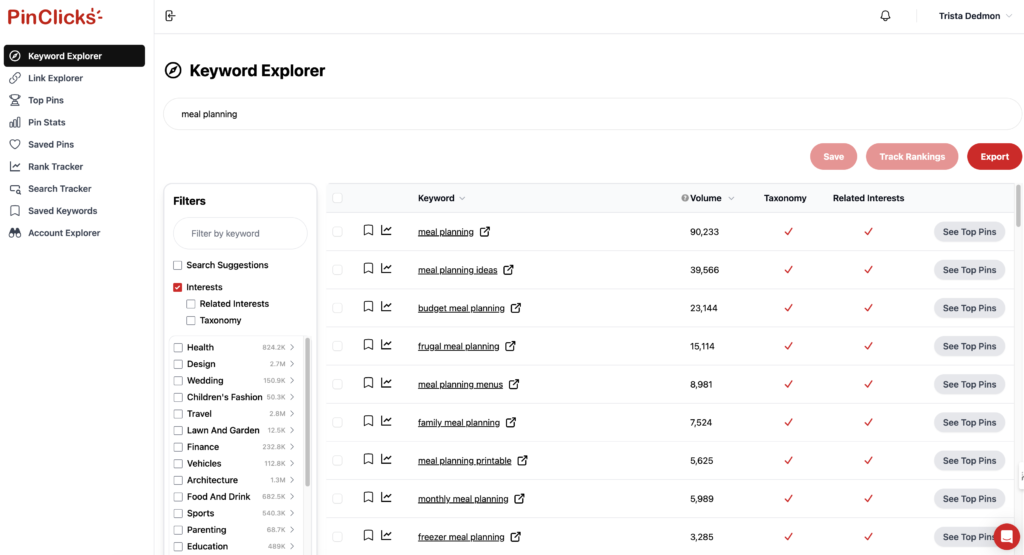
If you want a clearer view, a tool like PinClicks can help you see keyword volume and related terms in one place. It simplifies the process of choosing topics that already have demand.
This step removes a lot of uncertainty. You are no longer guessing what to write about. You are responding to what people are already looking for.
They also help your pin feel more relevant when someone sees it in search or their feed, which can increase the chance they click through.
Helpful Tip: Use Long-Tail Keywords First
When you are new, long-tail keywords are usually easier to target than broad keywords.
Instead of choosing a broad topic like:
- meal planning
- home organization
- morning routines
Look for more specific phrases like:
- easy meal planning for busy moms
- small pantry organization ideas
- 10 minute morning routine for beginners
These longer keywords are clearer, more specific, and easier to match with your content. They also help your pin feel more relevant when someone sees it in search or their feed, which can increase the chance they click through.
Step 2: Create One Post That Matches One Clear Search
Once you have a keyword, the next step is to create content that directly matches it. This is where many people overcomplicate things by trying to cover too much at once.
Instead, keep it focused:
- One problem
- One topic
- One clear outcome
This helps both Pinterest and the reader understand exactly what your post offers. It also makes the content easier to write and more useful to the person finding it.
Clarity matters more than volume at this stage. A single well-aligned post can bring more traffic than several unfocused ones.
This is also where slow blogging becomes powerful. You can learn more in How To Practice Slow Blogging in a Fast Internet Culture.
Helpful Tip: Match The Reader’s Exact Outcome
Once you choose a keyword, think about the exact result the reader wants.
For example, if someone searches:
- “small bedroom organization ideas”
They are not looking for general decluttering advice. They want specific ideas they can use in a small space.
Your post should focus on:
- clear examples
- simple solutions
- visuals or descriptions they can picture
This makes your content feel immediately useful and keeps the reader on the page longer.
Step 3: Create Multiple Pins For One Post
A common mistake is creating one pin per blog post and expecting it to perform. In practice, Pinterest works better when you give your content multiple entry points.
Each pin is another opportunity for your post to be discovered.
A simple approach is:
- Create 3 to 5 pins for each blog post
- Use slightly different titles for various angles and entry points of the user
- Use different images or layouts
This does not need to be complicated. Small variations are enough. The goal is to allow Pinterest to test which version resonates most.
Over time, one or two pins may begin to stand out. That is where your traffic starts to build.
Helpful Tip: Change The Angle, Not Just The Design
When creating multiple pins, vary the message behind each one.
For example, if your post is about meal prep, your pin titles could be:
- Easy Meal Prep Ideas For Busy Weeks
- Healthy Meal Prep For Weight Loss
- Simple Meal Prep For Weeknight Schedules
- Beginner Meal Prep Guide For Clean Eating
Each pin speaks to a different motivation, even though they lead to the same post.
Step 4: Use Keywords In The Right Places
Once you understand keywords, the next step is placing them where they matter.
You can keep this simple by including your main keyword in:
- The pin title
- The pin description
- The board name
This helps Pinterest understand what your content is about and when to show it.
If you want to go a step further, you can use PinClicks to find related keyword variations. This helps you expand your reach without needing to guess how to phrase things.
You are not trying to optimize everything perfectly. You are making your content easier to categorize and distribute.
Helpful Tip: Expand With Natural Keyword Variations
Pinterest understands related phrases, so you can widen your reach by using variations of your main keyword.
For example, if your topic is:
“budget home decor ideas”
You can also include:
- affordable home decor inspiration
- cheap decorating ideas for apartments
- DIY home decor on a budget
This helps your content show up for more searches without making it feel repetitive.
Step 5: Pin Consistently Without Overcomplicating It
Consistency is where the system starts to work. Without it, Pinterest does not have enough data to understand your content.
This does not require a large volume of work. It requires a steady rhythm.
You might:
- Pin a few times per week
- Add new pins when you publish a post
- Revisit older posts and create additional pins
The goal is to stay present on the platform in a way that feels manageable. This supports long-term growth without creating pressure.
If you want a calmer approach to staying consistent, read How to Practice Slow Productivity For Better Focus and Output.
What Getting To 1,000 Visitors Actually Looks Like

It helps to have a realistic expectation of how this builds. Your first 1,000 visitors will likely come gradually, not all at once.
You may notice:
- A few clicks here and there at first
- Pins starting to get saved
- One post beginning to get more traction than others
This is the stage where many people stop because it feels slow. In reality, this is where the system is beginning to take shape.
Traffic often comes from a small number of posts gaining momentum. Your role is to continue supporting that process.
How To Know If It’s Working
You do not need to track everything to understand progress. A few simple signals are enough.
Look for:
- Increasing impressions on your pins over time
- Saves, which show interest
- Gradual growth in clicks to your blog
You are looking for direction, not perfection. Even small movement means your content is starting to align.
This helps replace the feeling of being stuck with a clearer sense of progress.
The Calm Way To Approach Pinterest Growth
Pinterest works best when it is treated as a long-term system. It does not require constant attention or performance.
You are not trying to go viral. You are building a structure that brings people to your blog over time.
This approach supports:
- Clarity over confusion
- Consistency over intensity
- Sustainable growth over quick results
It aligns with the kind of business many people are trying to build. One that fits into real life rather than overwhelming it.
Closing
If you are trying to get your first 1,000 blog visitors, the path does not need to be complicated.
You do not need a large audience. You do not need perfect content. You do not need to be everywhere at once.
You need:
- One clear topic
- A few well-placed pins
- Consistent action over time
That is enough to begin.
Once you see even a small amount of traffic coming in, everything starts to feel more possible. The system becomes clearer, and your confidence grows alongside it.

Ready to build a profitable blog?
The Dream Blog Starter Vault is the complete, step-by-step path to a blog that earns passive income while you live your life.
Open the Vault